open_logo_c_ic

Parkland Institute

Ian Hussey on how organizations can start to evolve their internal work and governance practices in support of calls for racial justice.

Tell us about the Parkland Institute. How would you describe its purpose and what makes it unique? 

Parkland Institute is an Alberta-wide, non-partisan research centre within the Faculty of Arts at the University of Alberta. The think tank was founded in 1996, and all of our research, publications, and videos of our events are available for free on our website and through our media platforms (such as our YouTube channel). 

We produce and publish research on economic, social, cultural, and political issues facing Albertans and Canadians, using the perspective of political economy. More specifically, we do research on such issues as the gender wage gap, pay equity laws, health care privatization, Indigenous workers’ experiences in the oil sands industry, migrant workers, long-term care, minimum wage, diagnostic laboratory services, reproductive health services, increasing automation in the oil sands industry, fossil fuel pipelines, the Alberta coal phase-out, basic income, farm workers, the Alberta government’s budget and various taxation and resource royalty policies, employment standards and labour laws, among other topics. 

We are all navigating the global pandemic in different ways. What’s a key insight from how the Parkland Institute is responding to the crisis? 

Our research indicates that COVID-19 has hit the economic sectors that predominantly employ women the hardest, so publishing feminist political economy research is a key concern for us during this public health crisis. 

We recently published a feminist approach to Alberta’s COVID-19 response and, since most low-wage workers are women, we followed that publication up with a blog post on the benefits of raising the provincial minimum wage to a living wage

Unfortunately, the United Conservative provincial government is continuing its austerity agenda during the pandemic, so another key area of our research this year has been diagnostic laboratory service, privatization of our health care services, and changes to our labour laws and employment standards code that will negatively affect working Albertans. 

Tell us about how the Parkland Institute is making its work more inclusive and building engagement with different communities. Any tips or lessons to share with others in the sector about decreasing barriers to participation? 

We’ve been inspired by social movements and political initiatives in Edmonton and around the world to further racial and economic justice, and we understand that we need to improve our internal work and governance practices and processes to reflect our commitment to equity, diversity, and inclusion (EDI) principles. 

Parkland’s staff is fortunate to work under the guidance of an experienced and engaged Advisory Board comprising leaders from across Alberta’s post-secondary schools and community and labour organizations. Our staff also draws inspiration and guidance from our Research Committee that includes researchers working with various post-secondary institutions and labour and community groups. Parkland’s Advisory Board and Research Committee are both critical for our ongoing work to filter all of our work and governance processes through EDI principles. 

For example, this year our Advisory Board undertook a review of our research topics, publications, and events from the last year to start to evaluate our work output against EDI principles. The board used this initial review in their ongoing discussion of how to change Parkland’s constitutional document to reflect our commitment to EDI. 

The board also created an EDI standing committee of the board to continue its work of evaluating how best to infuse EDI principles throughout the organization’s work and governance processes, including how new board and research committee members are chosen, what research topics Parkland chooses to work on, how we select researchers and writers to work with, what topics we choose to highlight at our annual conference and other events, how we select speakers at our events, and how we try to foster a fun and inclusive environment for our supporters and volunteers to participate in. 

For people looking to engage with you, how can they get involved? Who can they contact? 

We encourage folks looking to get involved with the Parkland Institute to sign up to receive our email updates and to follow us on Facebook, Twitter, and YouTube. If you’d like to be put on our volunteer list, please email Sharlene at parkland@ualberta.ca


The Parkland Institute is a non-partisan public policy research institute at the University of Alberta.


This is an unprecedented moment for democracy in Canada so we created Sector Spotlight to learn about how leading practitioners are responding to it. Have ideas for our next Sector Spotlight? Get in touch!

Doctors for Defunding Police

Semir Bulle of Doctors for Defunding Police on how professions can use their privilege to address systemic racism.

You are a co-founder of Doctors for Defunding Police. Tell us about your background and the purpose of this work? 

My parents were refugees, I grew up on more of the low-income side of Toronto where I had a lot of interaction with the police. I think in one year I got carded over a dozen times. Everyone in my community had similar experiences if not worse. When I came to the University of Toronto for medical school, I found other doctors doing community organizing. That led to Doctors for Defunding Police which is a collective of BIPOC doctors committed to the health of our communities. We work in the Greater Toronto Area and have come together to stand in solidarity with calls from Black and Indigenous communities to address systemic anti-Black and anti-Indigenous racism.

When we are dealing with a mental health crisis or a drug overdose, we have to consider whether calling the police will make situation any better or worse for our patient. We recognize that our healthcare system is complicit in systemic racism and often works in concert with police services, especially as it relates to mental health crises. Defunding the police and reallocating funds to support response systems backed by public health research will make our communities safer and healthier.

We are all navigating the global pandemic in different ways. What are some key insights about how Doctors for Defunding the Police mobilized during this time?  
 
Doctors for Defunding Police came together in the pandemic and this moment is changing the way we organize. We have done everything online – with Twitter we can be transparent about who we are and our work. We can share information with our communities at work and in our lives – this is how we move forward and how we have built our audience. By providing information and education about issues that are impacting them and that the media isn’t addressing. People who are working on the frontlines, essential workers, they don’t have time to describe how systemic issues are affecting them. That’s our job – our job is to provide a base of support that reflects their reality and to show we actually care. Bringing people together in this way online creates a buffer and a base from which to push for institutional change.

In your press release you describe policing as a public health crisis. What is the significance of using health as a lens to address systemic anti-Black and anti-Indigenous racism? Is there a connection to a healthy democracy?

Systemic racism is a matter of life and death to us. As doctors we are advocates and part of the community, healthcare doesn’t stop the second you step out of our office. In medical school we are taught about the social determinants of health – how medicine is 20% of the solution but the other 80% is within our environment – our communities. A recent report from the Ontario Human Rights Commission found that Black people are 20 times more likely to be shot than someone who isn’t Black. How can we function in society knowing this?

We are trying to connect every dot – to acknowledge the significance of intergenerational trauma, to acknowledge that better resourced neighbourhoods have a better quality of life, to acknowledge that kids from over-policed neighbourhoods end up in the criminal justice system. Democracy is supposed to be about people feeling like they have a voice in shaping their communities. That’s not happening right now and we want to change that. During the pandemic in Toronto we know that racialized communities have had it the worst – it’s where many of our essential frontline workers live, where social distancing has been the hardest and where access to mobile testing units hasn’t been available. What are the repercussions for this? We need people to understand democracy is about being part of a community and something greater. We think that society will function better when the quality of life of all citizens is centred.

Why is it important to organize as a profession right now?

Doctors have a lot of privilege and we trying to leverage that along with our community knowledge to call for improvements in our society. The pandemic has given us an important window to make a difference. We are aware that other professions can’t necessarily join us on this path – they face barriers. But we want to at least show what’s possible, that you can organize and if others want to join us, we want them to know that we’ll push with them. The digital age means we don’t have be siloed in our efforts, we need to work together and the groups with the most privilege need to call for change first because they can get away with the most.

Could you share an idea or initiative related to increasing civic engagement or democratic participation that inspires you?

I’m inspired by Nurses for Abolition who see the over-incarceration of Black and Indigenous people as a public health issue. They are based in Halifax and are using their professional base to call for the abolition of police and prisons.

For people looking to engage with you, how can they get involved? Who can they contact?

We are on Twitter and Facebook and have a mailing list. Our website has an open letter about policing as a public health crisis – we welcome doctors to be added as signatories.


Doctors for Defunding Police started as an initiative by a few doctors concerned about the toll anti-Black and anti-Indigenous policing was taking on the health of residents in the City of Toronto. We are a collective of BIPOC doctors committed to the health of our communities.


This is an unprecedented moment for democracy in Canada so we created the Sector Spotlight to learn about how leading practitioners are responding to it. Our hope is to support knowledge sharing and spark new connections by profiling a wide range of initiatives from regions across the country. Have ideas for our next Sector Spotlight? Get in touch!

The Prosperity Project

Lois Nahirney on how the success and well-being of women is directly tied to Canada’s social and economic recovery from COVID-19. 
 

Tell us about the Prosperity Project, how would you describe its purpose and what makes it unique?

The Prosperity Project was founded to recognize and counteract the disproportionate impact that COVID-19 is having on Canadian women. At its core, the project is about advancing gender equity and ensuring that women’s economic prosperity is achieved. We have made important progress over the last 40 years and it is critical to ensure that the pandemic does not erase that progress. We believe that by working for a prosperous and fair future for all women, we will improve society as a whole.

The Prosperity Project is a true collaboration. It brings together a diverse group of over 60 women leaders from across Canada who serve as the founding visionaries. It is the brainchild of Pamela Jeffery, who had the idea that by bringing together women leaders from across the country we could help to mitigate the impact of the pandemic on women. We are also currently in the process of onboarding another hundred visionaries and other supporters to ensure that we are representative of Canada’s population.

We are all navigating the global pandemic in different ways. What’s a key insight from how the Prosperity Project is responding to the crisis?

These are challenging times for our communities, our families and our country. Women have had a higher percentage of job loss and job layoffs during the pandemic. They have also had more responsibilities at home including full-time childcare, homeschooling and elder care while trying to maintain their job productivity. The Prosperity Project is about helping to address this situation. Focusing on the success and well-being of women is critical to the social and economic health and recovery of Canada.

We have created five different initiatives in response to the pandemic. The first matches professionals with non-profits focused on women – the professionals help these organizations reinvent their business models and find ways forward to meet the urgent and growing needs of the women they serve. The second is our Prosperity Study which is Canada’s first inclusive on-line national long-term multi-generational study of 10,000 women in all socio-economic groups. It will uncover and share practical solutions that will provide insights to employers and policy-makers on actions that need to be taken to improve gender equality.

We know that women make or influence up to 80% of household purchases so we created the Prosperity Project Household Spending Index to serve as a barometer of confidence in the Canadian economy during the COVID-19 recovery and post-recovery periods. It will measure month to month variation in economic activity based on a panel of diverse women from across Canada in all socio-economic groups. Our fourth initiative is a campaign designed to increase the labour force participation rate of women, the number of female STEM graduates and workers, the number of women going into skilled trades, and the number of women in leadership and decision-making roles (and in the pipeline to these roles) in the COVID-19 pre-recovery, recovery and post-recovery periods.

Lastly we will track women in executive roles, senior management roles and in the pipeline to senior management within Canada’s largest 500 public companies, crown corporations and multinational subsidiaries. Through this inclusive research, we will shine a light on women who also identify as Indigenous, women of colour, persons with disabilities and/or LGBTQ2+. The intention is for this data to increase transparency, accountability, and inform policies and best practices around gender equality and succession planning.
Our response to the crisis is about ensuring that a gender lens is applied to Canada’s recovery from the pandemic. To do that we are drawing on a wealth of knowledge from women leaders across the country to get ideas and support. We want our response to be a true collaboration that reflects Canadian society and recognizes the particular needs of women in communities across the country.

We know that women – particularly women of colour and those working on the frontlines – have been disproportionately impacted by COVID-19. School closures and a shortage of daycare spaces have compounded this. How does this relate to the Prosperity Project’s work?

Those issues have been at the heart of how the Prosperity Project has been put together. We want to ensure the people we get engaged with the project understand and represent women of colour, women on the frontlines, the women that are disproportionately impacted by the pandemic. And each of our initiatives is aimed at addressing this reality as well.

Tell us about how the Prosperity Project is making its work more inclusive and building engagement with different communities. Any tips or lessons to share with others in the sector about decreasing barriers and increasing participation?

We apply an intersectional and inclusivity lens to serve women who also identify as Indigenous, women of colour, refugees, persons with disabilities and/or LGBTQ2+. We recognize that different approaches are required to meet the distinct needs of all Canadian women including First Nations, Inuit and Métis women. We are currently identifying partner organizations in order to deliver our programs in a socially and culturally sensitive way. We also want to inform organizations and businesses about the things that they can be doing to be inclusive and accommodating – to make that approach part of how we do business.

Are there specific requests that the Prosperity Project has for the broader sector? Things you need help with, problems you’re trying to solve or wishes you have?

Women are 50% of the economy. A recent study showed when you advance women’s equality in Canada, it has the potential to add 0.6% annual incremental GDP growth. So if we can get women involved more – even 50 minutes more a day per week – in paid working hours it is worth about $150 billion in our economy over five years. If organizations can engage women just that much more each week that will make a substantial impact on the economy and will be essential to counteracting the recessionary effects that this pandemic is having on our country.

We want all sectors, government organizations and individuals to recognize and acknowledge that the pandemic has had a disproportionate impact on women and that this impact is going to set back the limited progress that has been made in terms of advancing gender equity in Canada. Women earn 75% to 85% for every dollar that men earn. We need to close that wage gap and gender gap.

Second we want recognition that every organization and person can take a step to address this inequality. We have specific asks for government and private business. For government, we’re asking specifically for return to school plans to safely reopen elementary schools as soon as possible. As long as elementary schools remain closed more women will be unable to return to work. It creates incredible pressure for women when they are trying to do their jobs, care for children and help them with their schoolwork. We also need an affordable national childcare program. Unlike most industrialized countries, Canada doesn’t have one. Quebec has been an example where a family policy was introduced in 1997 and it increased Quebec’s labour force participation to about 81% in 2016 compared to just 75% in Ontario. We know that when there is a good childcare program it is to the benefit of women and families and it outweighs the costs. We also want government to regulate protection of frontline workers. We have had so many healthcare workers file workplace injury claims related to COVID, the majority of these are filed by women. So we are calling on government to keep women safe and protected at work.

There is so much that corporate Canada can do to take some very deliberate action. We want businesses to start setting female representation workforce targets related to pre-COVID 19 levels and higher. And we want to measure and reward corporations and companies that meet these targets. That means you looking at your organization and tracking what’s happening from your starting point. Set policies to mitigate gender bias and really help to recover from the disproportionate impact that the pandemic has had on women’s labour force participation. Women need to be represented – they are half our population.

We need to remember that when we do the return to work plans that we apply a gender lens. The return to work needs to be an equitable arrangement for both men and women. Who is getting to come back to work, who is staying at home and supporting the needs there and how do we ensure there is a balance?

We recognize that we need to deepen and broaden the talent pool through skills development. Merit and diversity aren’t mutually exclusive. There is unconscious bias in how women are recruited, promoted and receive training opportunities. Women and in particular women of colour are less likely to be treated equally in terms of performance based promotions and compensation. So we need a gender and diversity lens when we’re considering how we hire and deepen the talent in our organizations. When we can get women to succeed we all prosper. If we can get government and business to take some of these actions we will not only recover from the pandemic but make progress and realize an equitable country that we aspire to have.

What’s at stake if we don’t get this figured out?

If we don’t get this figured out we’re going to see a reduction in democratic participation in this country and we’ll see a reduction economically. If we can’t get women back to work there’s no way we can return to past GDP levels and see an increase in the GDP in our country. It is absolutely essential. We know that when we have a balance of men and women and diverse individuals in our organizations making decisions for our country, making decisions in terms of products for the market, that we get better quality outcomes. So what’s at stake is a true democratic country where we are supporting individuals, where they are represented and we are creating a sustainable future.

For people looking to engage with you, how can they get involved? Who can they contact?

We would love for people to get involved by volunteering for the initiatives and the studies that are being done. We have had a beautiful response from Canadians across the country and we want to build on that engagement. Our only criteria for participation is sharing our passion to mitigate the disproportionate impact of COVID-19 on women and that they help apply this inclusive lens on our work. We are grateful for any form of support from individuals and organizations. We all have a role to play and encourage you to visit our website and follow up on our social channels (Twitter, LinkedIn).

The Prosperity Project™ is a new not-for-profit organization founded to mitigate the impact of the COVID-19 pandemic on Canadian women who are being disproportionately affected. The Project is pan-Canadian in scope and fills an important need to explicitly link women and prosperity, underscoring the economic importance of gender equality during the COVID-19 pre-recovery, recovery and post-recovery periods.

This is an unprecedented moment for democracy in Canada so we created Sector Spotlight to learn about how leading practitioners are responding to it. Have ideas for our next Sector Spotlight? Get in touch!

Institute for Change Leaders

Duncan Pike from Institute for Change Leaders on how the pandemic is underscoring the power of solidarity and storytelling. 

Tell us about the Institute for Change Leaders. How would you describe its purpose and what makes it unique?

Our mission at the Institute for Change Leaders is to ensure organizers are continually developing the skills that they need to win social change. The Institute does this by teaching organizing strategies and providing a platform for the growth of a network of organizers.

Our trainings are unique because most student time is spent in small-group settings where students practice specific skills, and receive coaching from experienced organizers. The Institute has already taught over 5,000 students, and cultivated a team of 30+ small group facilitators. We deliver our full curriculum in regular weekend sessions at Ryerson University, and we work with organizations to deliver tailored trainings in their workplaces.

Our curriculum comes from Marshall Ganz, a Harvard professor who codified the relationship-building organizational framework we teach after years of organizing with the Civil Rights and United Farm Workers movements. He was a key trainer and organizing strategist behind President Obama’s 2008 presidential campaign. The Institute offers the first accredited Marshall Ganz-based community-organizing course in Canada.

We are all navigating the global pandemic in different ways. What’s a key insight from how Institute for Change Leaders is responding to the crisis?

We experimented with online trainings in 2019, and by early this year we felt quite confident with our ability to meet our own standards of instruction and coaching over video. In that sense we were fortunate that our mission could be carried out online with relatively little disruption. This isn’t to say that there haven’t been obstacles. Relationship-building is at the core of our methodology and approach to achieving social change, and whatever the conveniences of Zoom, it’s possible that nothing can fully replace the spark of face-to-face meetings for developing strong personal connections.

That said, one of our key teachings is the power of personal storytelling to connect over shared values and experiences, and overcome obstacles of time, space, and sketchy internet connections. We’ve made use of this lesson in order to build solidarity within our own community, setting up online mindfulness sessions, organizing-focused books clubs, and drop-in opportunities for alumni, facilitators, volunteers and staff to connect to share their own experiences of the pandemic.

Over the past few months we have seen groups seize this moment of uncertainty to advance racial and economic justice in their communities. What are your thoughts on this moment in community organizing?

The pandemic has exacerbated pre-existing social, racial and economic inequalities, and movements to confront them have taken on a corresponding intensity and urgency. We’ve seen this energy first hand across a number of different issue areas and communities.

In early April, we partnered with the Association of Early Childhood Educators of Ontario (AECEO) to run an online training for over 200 early childhood educators (ECEs) and parents to provide them the skills they need to build power, confidence and solidarity. It was an amazing journey, and privilege to work with such an inspiring, dedicated group of changemakers. 10 days after completing our training, ECEs held a Virtual Rally of 1,500 demanding a reopening plan that ensured quality and safety for all. 21,000 viewed this rally and both levels of government listened. In July, the Government of Canada announced $625 million in federal funding for the child care sector, a promising step in the struggle for decent work for ECEs and the fight for a publicly funded system.

In June we had the pleasure of hosting long-term care (LTC) workers in a handful of connect and share sessions, where LTC workers were able to build solidarity over shared stories and shared laughs. The sessions gave an outlet for workers on the frontlines of dealing with COVID and press surrounding the maltreatment of long-term care residents. They also came up with strategies and tactics on how to fix long term care so seniors can live in dignity, and workers get decent wages with stable, rewarding employment.

And this August we co-hosted a joyful celebration with 200 graduates of the Black Youth Leadership Program, a joint project of ICL and For Youth Initiative (FYI), that worked with youth from across Ontario to develop their leadership skills and confront anti-Black racism in their communities.

The pandemic continues to do enormous damage, and the struggle to shape our post-Covid future will be intense, but it’s difficult not to feel hopeful when working with such amazing groups of activists and organizers.

What’s one big challenge you see Canada’s democracy facing? How are you working on this challenge, what solutions do you propose?

The greatest challenge Canadian democracy faces continues to be the domination of our political system by those with the greatest economic power, and the corresponding dispossession and disempowerment of working class, racialized, Indigenous, and historically marginalized peoples. The only solution to this is for the majority of people who are not represented by the political system to organize themselves, develop solidarity and political power, and build bottom-up institutions that work for the many. We hope that our efforts to teach grassroots organizing skills may contribute a small part to this struggle.

Could you share an idea or initiative related to increasing civic engagement or democratic participation that inspires you?  

ICL is a part of the Leading Change Network, a global community of organizers, educators, and researchers that teach the Ganz methodology for social change. They host regular meet-and-connect sessions with members from around the work to share knowledge, tell stories, and build international solidarity. It’s incredibly inspiring to connect with organizers from other countries, learn about their work, and find areas of common experience. During the last session I spoke with a woman doing work with formerly incarcerated peoples in Oakland, an economic development activist from Nigeria, and a social entrepreneur from Palestine, with whom we are now collaborating on a proposal. Looking beyond your own backyard, and your own country, can be invigorating, and is a reminder that the challenges we face are ultimately global in nature.

Tell us about how Institute for Change Leaders is making its work more inclusive and building engagement with different communities. Any tips or lessons to share with others in the sector about decreasing barriers to participation?

We are constantly working to expand our training to be more accessible to working class, racialized, and Indigenous communities who have the most to gain from building the skills we teach.

To give one example, most curricula about successful organizing campaigns do not include Indigenous content. To help Indigenize our courses, we chose to highlight a case study of Attawapiskat’s struggle for a new school from 1979 until the new school was built in 2014. This campaign is known as Shannen’s Dream, after the late student leader Shannen Koostachin. We examined how Shannen and her contemporaries engaged students, teachers, and citizens from across Canada to amplify the voice of youth from Attawapiskat, and integrated these lessons into our course material.

The movement’s campaign strategies are a powerful illustration of Ganz’s theories and a stirring example of Indigenous power and leadership. We piloted the new curriculum in Indigenous environments with feedback from participants and specialists in Indigenous studies. We plan to continue to develop case studies highlighting the power communities have when they organize collectively and politically.

Are there specific asks that the Institute for Change Leaders has for the broader sector — things you need help with, problems you’re trying to solve or wishes you have?

Sustaining the participation, strength and health of this community over the long-term will be an ongoing challenge amid the pandemic, and we would love to hear from others in this sector about how they’re responding.

For people looking to engage with you, how can they get involved? Who can they contact?

Visit our website and our social channels (Twitter, Facebook, Instagram). You can also get in touch by emailing changeleaders@ryerson.ca. And this fall Olivia Chow will be teaching SSH502: Community Action Research, a three-month credit course at Ryerson University on community leadership, organizing and action. This course teaches hands-on organizing skills so you can inspire your community to take action for social change. This course will be supported by a team of experienced organizers who will provide small group and one to one coaching. .

The Institute for Change Leaders in a nonprofit organization dedicated to ensuring progressive organizers and community-based organizations are continually developing the skills they need to transform the resources they have into the change they want. We do this through teaching organizing strategies and providing a platform for the growth of a network of organizers.

This is an unprecedented moment for democracy in Canada so we created Sector Spotlight to learn about how leading practitioners are responding to it. Have ideas for our next Sector Spotlight? Get in touch!

Samara Centre for Democracy

Michael Morden from the Samara Centre for Democracy on the importance of institutions to maintain a high bar of democratic practice while adapting to shifting terrain.

Tell us about the Samara Centre for Democracy. How would you describe its purpose and what makes it unique?

The Samara Centre is dedicated to strengthening Canadian democracy. We focus on citizens, on institutions, and on intermediaries like political parties. We work hard to find concrete solutions to both institutional and cultural problems, and we really believe that ethical and effective public leadership is central to a functioning democracy. We pride ourselves on being rigorously non-partisan, and empiricist.

We are all navigating the global pandemic in different ways. What’s a key insight from how Samara is responding to the crisis?

When the lockdown started, we launched our Democracy Monitor to study how representative democracies were adapting in real-time. One of the big lessons, for us, has been that when faced with a set of hard choices, and when normal is impossible, it’s important to return to first principles and identify what matters most. Starting from those core values makes it possible to embrace adaptation, while also maintaining a high bar for democratic practice. We’ve applied that approach to legislatures, for example, by arguing for the adoption of a quasi-virtual Parliament which, while imperfect, can guarantee ongoing scrutiny and representation in the short-term.

We have seen a lot of discussions recently about governments potentially using digital contact tracing apps to help contain the spread of COVID-19. This raises some important questions about balancing effectiveness with privacy. How does this relate to Samara’s work?

Our frustration with this conversation is that so far, it has too-often overlooked the governance dimension. On the one hand, there are very significant concerns with respect to digital contact tracing which can’t be satisfactorily solved in app design alone. On the other hand, this challenge of balancing concerns like privacy and equity with concerns like public safety is not radically new or unique, and it’s possible that solutions may lie in well-designed democratic governance. Institutions matter and decisions need to be made in public. We’ve set out some simple recommendations for how democratic oversight of contact tracing apps might work, grounded into multiple dimensions of internal and external review.

What’s one big challenge you see facing Canada’s democracy? How are you working on this challenge or what solutions do you propose?

The political class is still fairly insular and unrepresentative, and most Canadians don’t sense an invitation into public life. We see this starkly in our surveys of citizens, who overwhelmingly don’t see themselves in political parties or public leadership. We want to address this problem from a variety of angles. We’re starting by looking at the gatekeepers—specifically, we’ve been studying how parties select their nominees, and how law and policy can make those processes more open and fair. But we also want to send a message directly to Canadians that politics isn’t a dirty word, and that they have a contribution to make.

Could you share an idea or initiative related to increasing civic engagement or democratic participation that inspires you? 

We’re inspired by the so-called “deliberative wave” happening across the world, in which everyone from national governments to community associations are convening randomly selected citizens for long-form discussions based on public learning. The benefits of deliberation in a representative democracy are broad, and they include giving people a unique opportunity to practice and master democratic citizenship. We think the next step is to strengthen the relationship between these kinds of deliberative exercises and representative institutions like legislatures.

Tell us about how Samara is making its work more inclusive and building engagement with different communities. Any tips or lessons to share with others in the sector about decreasing barriers and increasing participation?

We’ve been exploring our role in conversations with new friends and sector partners, and are keen to discover how we can be useful to different communities. Internally, we’re looking at how we can mobilize the research resources we have to tell a truer and fuller story about how Canadians are experiencing this democracy differently. But we’re not experts on this front; we still have lots to learn.

Are there specific requests that Samara has for the broader sector? Things you need help with, problems you’re trying to solve or wishes you have?

We’re eternally asking ourselves how we can turn the knowledge and experience we have into application-ready resources for the broader democracy sector. We’ve accomplished lots of research over the years but we could always do a better job of getting that research out to the people who could benefit, in an accessible way. We’d always love to hear from colleagues, particularly those working at the grassroots and community level, about what aspects of our work are useful, and where else you think we could be a service to the democracy sector.

For people looking to engage with you, how can they get involved? Who can they contact?

We can be reached at info@samaracanada.com, and I’m personally available at mike.morden@samaracanada.com. The best way to follow along with our work is to sign up for our newsletter at www.samaracanada.com.


The Samara Centre for Democracy is a non-partisan charity dedicated to strengthening Canada’s democracy. The Samara Centre produces innovative, action-oriented research that illuminates the evidence and reforms needed to make Canadian politics more accessible, responsive, and inclusive. Through original engagement programming, we provide active citizens and public leaders with tools and resources designed to engage Canadians in their democracy.


This is an unprecedented moment for democracy in Canada so we created Sector Spotlight to learn about how leading practitioners are responding to it. Have ideas for our next Sector Spotlight? Get in touch!
Everyone’s Canada

Zain Velji on how Everyone’s Canada uses storytelling to reaffirm the value of pluralism, multiculturalism and immigration. 

Tell us about Everyone’s Canada. How would you describe your purpose and what makes you unique?

Everyone’s Canada was created in the summer of 2019 in response to a concerning narrative that was emerging across the country — a narrative that sought to undermine Canada’s commitment to multiculturalism, pluralism, and immigration. Anti-immigrant sentiment, which was being stoked and weaponized by some politicians ahead of the federal election, seemed to be bubbling up across the country.

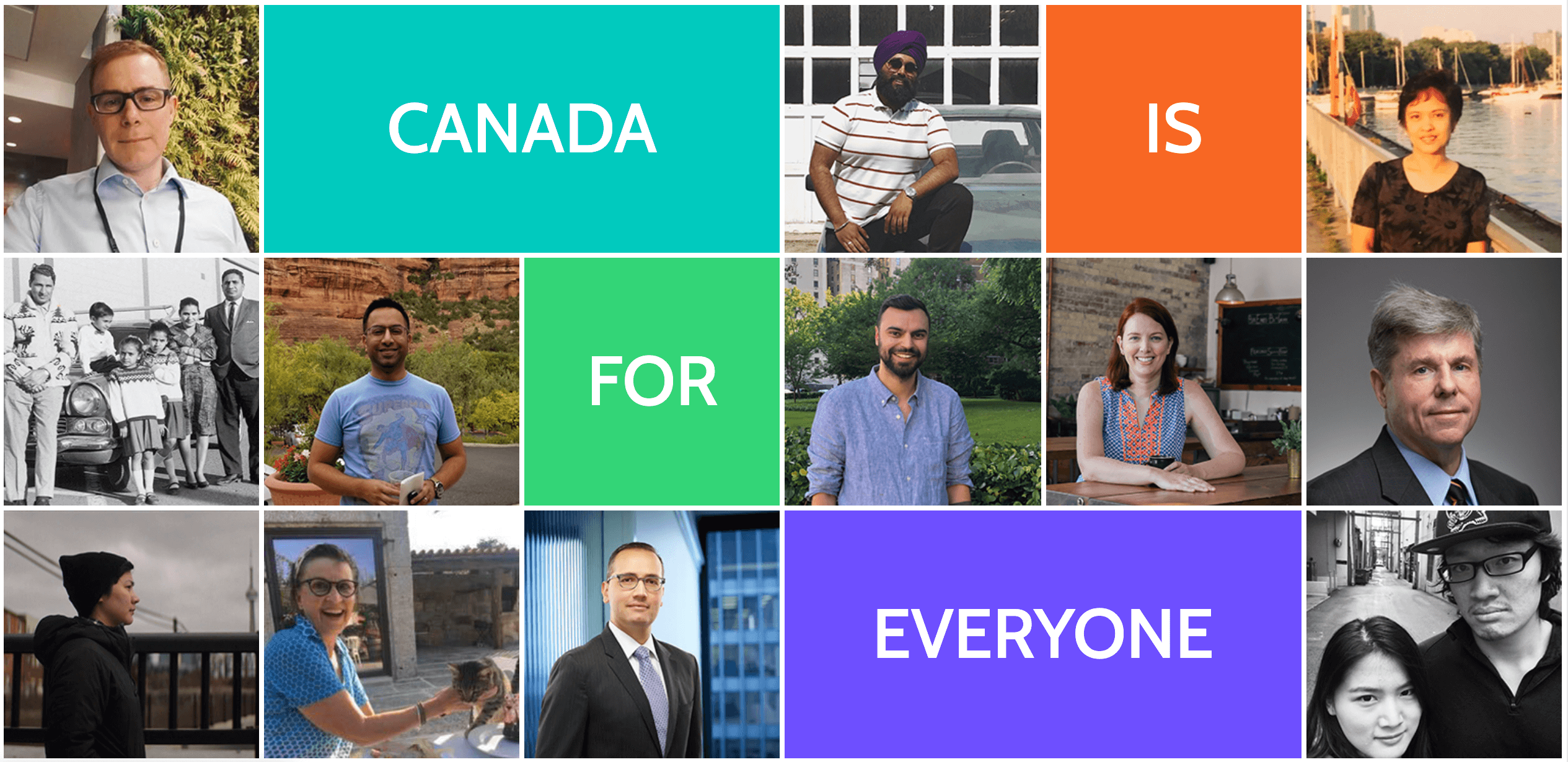
EC’s response was to share an extremely simple response to this narrative, though one that we sometimes take for granted: Canada is for everyone. It doesn’t matter what you look like, where you come from, or what binds your conscience because Canadian identity isn’t tied to a particular race or ethnicity, but is rather built around a set of aspirations.

What makes our organization unique is our commitment to sharing and uplifting this message through story-telling that highlights diverse perspectives. In 2019, we launched a popular series called #MyCanada, which encouraged Canadians to share their family history and their perspective on what Canadian identity means. The series acted as a reminder that there is no fixed or permanent concept of a Canadian — rather, there are only complex, layered, and competing concepts, all founded upon a dedication to diversity and pluralism.

This simple message seemed to resonate with various individuals and communities, particularly in the midst of what had become a noisy and divisive election. Moving forward, EC remains committed to using storytelling to push back against nascent or existing movements to undermine our collective commitment to multiculturalism in Canada, such as Bill 21 in Quebec, and highlighting ways that Canadians are fighting for a stronger future, such as the ongoing efforts to implement the Truth and Reconciliation Commission’s calls to action.

This is a critical moment for commitment and action on anti-black racism. It is prompting crucial conversations about structural inequality and violence that results in the loss of Black lives.  How does this relate to the work of Everyone’s Canada?

In line with EC’s focus on storytelling, our organization is currently developing a new podcast series called Black in Canada, which will introduce listeners to different perspectives on the Black experience in Canada. While much of the media is focused on the social upheavals and protests occurring in the United States, EC hopes to highlight the unique and multifaceted ways that anti-Black racism operates in Canada, and the efforts that are underway to combat it.

We are all navigating the pandemic in different ways. What’s a key insight from how Everyone’s Canada is responding to the crisis?

EC has sought to highlight the very concerning and underreported fact that COVID-19 has disproportionately impacted racialized communities in Canada. During the early stages of the pandemic, our organization focused on raising awareness about the COVID-19 outbreaks at meat processing plants in Alberta, which predominantly impacted immigrant and racialized communities in the province. Through op-eds, radio interviews, and social media, we aimed to highlight the authorities’ failure to protect vulnerable workers, which we believed too many people were willing to overlook.

This COVID-19 pandemic is a tragic example of how inequity and systemic racism hinder our ability to respond to a health crisis. It offers a reminder of the importance of fighting for an inclusive and equal Canada, one that makes an effort to protect and support marginalized or underrepresented communities.

What’s one big challenge you see facing Canada’s democracy? How are you working on this challenge or what solutions do you propose?

We believe that anti-immigrant sentiment is one of the greatest challenges Canada faces today. This sentiment has emerged despite the fact that immigration is a central component of our country’s history, and key driver of our economic growth today. As a country completely comprised of immigrants and Indigenous people, efforts to undermine immigration can only take the form of racism, xenophobia, and discrimination. Only by reaffirming and highlighting the value of multiculturalism, pluralism, and immigration, can our country move forward without descending into divisive and dangerous politics.

Tell us about how Everyone’s Canada is making its work more inclusive and building engagement with different communities. Any tips or lessons to share with others in the sector about decreasing barriers and increasing participation?

EC is committed to uplifting and sharing the work of other groups within the sector, and encourages different communities to reach out for collaborative opportunities. We often receive emails from other groups, asking us to highlight or share their work on social media, encouraging our followers to get involved.

Are there specific requests that Everyone’s Canada  has for the broader sector? Things you need help with, problems you’re trying to solve or wishes you have?

If you have a story to tell we would love to hear it from you. We are trying to grow our base of individuals to be profiled. And your story just needs to be your story – what does it mean to be Canadian? What is your ambition for Canada? And how would you describe the values of multiculturalism and diversity today.

For people looking to engage with you, how can they get involved? Who can they contact?

Visit our website and check us out on Facebook and Twitter. You can also email us (info@everyonescanada.ca).

Everyone’s Canada challenges an emerging narrative in Canada that undermines our commitment to multiculturalism, pluralism, and immigration. A narrative that claims that Canada only belongs to those of a certain background and experience, preventing many Canadians from calling this country home.


This is an unprecedented moment for democracy in Canada so we created Sector Spotlight to learn about how leading practitioners are responding to it. Have ideas for our next Sector Spotlight? Get in touch!


Strengthening Canadian Democracy Initiative

Dr. Jennifer Wolowic from the Strengthening Canadian Democracy Initiative at SFU Morris J. Wosk Centre for Dialogue discusses the links between disruption, resilience and thoughtful action.

Tell us about Strengthening Canadian Democracy. How would you describe its purpose and what makes it unique?

The Simon Fraser University Morris J. Wosk Centre for Dialogue’s Strengthening Canadian Democracy Initiative is a catalyst for creating a more resilient democratic culture across all communities in Canada.The Centre is researching what is driving views of democracy and what is shaping our democratic culture for better or for worse. We develop collaborations with institutions, practitioners, and citizens. We then evaluate the results of these collaborations to identify what works, when, and how to improve democracy.

We are all navigating the global pandemic in different ways. What’s a key insight from how Strengthening Canadian Democracy is responding to the crisis?

During times of crisis, the cracks in our business-as-usual patterns become more visible. Disruptions can either cause these cracks to grow or be catalysts for change. As you know, this is a moment when many groups– established and brand new– are embracing a “think tank” mentality and proposing new ideas. It’s an energy that is needed and is helping the government quickly respond and revise policy to address a complex crisis.

During this time, we’ve embraced the role of “do tank.” Our Democracy Team has taken a leadership role within Morris J. Wosk Centre for Dialogue’s Covid-19 response and recovery efforts. We’ve been busy creating projects large and small to help ease anxieties such as crowdsourcing public questions to guide authorities, creating resources for youth, and restructuring our democracy pilots.We are focusing our energy on strengthening democracy by reinforcing the social infrastructure of our communities and creating greater resilience and equity in these shifting times.

What’s one big challenge you see Canada’s democracy facing? How are you working on this challenge, what solutions do you propose?

There are opportunities to grow the collaborations across the democracy sector in Canada. We see the Open Democracy Fellow as a part of our work to bolster the sector and create stronger pan-Canadian collaborations.

Could you share an idea or initiative related to increasing civic engagement or democratic participation that inspires you? This could be related to your work or something you see happening in the sector.

One of our pilots to identify effective interventions is a partnership with CityHive. Their City Shapers program is a cohort-based, civic education program that brings together 18 to 30 year olds from across Metro Vancouver to learn about civic engagement and how cities work. Together, they explore both formal and informal ways of getting involved and collectively shaping the future of our communities, from activism to online dialogues to running for political office. The second of three cohorts is launching in May and will be looking at resilient communities. Participants will be exploring how resilience is created and what it means for communities and cities in crisis.

Tell us about how Strengthening Canadian Democracy is making its work more inclusive and building engagement with different communities. Any tips or lessons to share with others in the sector about decreasing barriers to participation?

Our Democracy Spark Grant program has invited public libraries across British Columbia to apply for funding to support programming exploring the role of libraries in democratic engagement in three thematic areas: climate change, social isolation, and local solutions. Eighteen different libraries across BC are taking advantage of the opportunity. The grants support costs related to designing programming or making programming more accessible for underserved communities. The grants also support libraries to administer and submit back evaluation data to the SFU Morris J. Wosk Centre for Dialogue. Results will be compiled and shared publicly to increase awareness and support for diverse democratic engagement opportunities.

Are there specific asks Strengthening Canadian Democracy has for the broader sector – things you need help with, problems you’re trying to solve or wishes you have?

We want to see the sector to keep talking to each other. Keep looking for alignment and complimentary programming. Together we are key to the resilience of Canada’s democratic culture.


SFU’s Morris J. Wosk Centre for Dialogue creates real-world impact for society’s most pressing challenges by using dialogue and engagement to co-create solutions, exchange knowledge, support community-engaged learning, and to build the capacity of others in the knowledge and practice of dialogue. Follow @SFUDialogue.


This is an unprecedented moment for democracy in Canada so we created Sector Spotlight to learn about how leading practitioners are responding to it. Have ideas for our next Sector Spotlight? Get in touch!