

open_logo_c_ic

Samara Centre for Democracy

Michael Morden from the Samara Centre for Democracy on the importance of institutions to maintain a high bar of democratic practice while adapting to shifting terrain.

Tell us about the Samara Centre for Democracy. How would you describe its purpose and what makes it unique?

The Samara Centre is dedicated to strengthening Canadian democracy. We focus on citizens, on institutions, and on intermediaries like political parties. We work hard to find concrete solutions to both institutional and cultural problems, and we really believe that ethical and effective public leadership is central to a functioning democracy. We pride ourselves on being rigorously non-partisan, and empiricist.

We are all navigating the global pandemic in different ways. What’s a key insight from how Samara is responding to the crisis?

When the lockdown started, we launched our Democracy Monitor to study how representative democracies were adapting in real-time. One of the big lessons, for us, has been that when faced with a set of hard choices, and when normal is impossible, it’s important to return to first principles and identify what matters most. Starting from those core values makes it possible to embrace adaptation, while also maintaining a high bar for democratic practice. We’ve applied that approach to legislatures, for example, by arguing for the adoption of a quasi-virtual Parliament which, while imperfect, can guarantee ongoing scrutiny and representation in the short-term.

We have seen a lot of discussions recently about governments potentially using digital contact tracing apps to help contain the spread of COVID-19. This raises some important questions about balancing effectiveness with privacy. How does this relate to Samara’s work?

Our frustration with this conversation is that so far, it has too-often overlooked the governance dimension. On the one hand, there are very significant concerns with respect to digital contact tracing which can’t be satisfactorily solved in app design alone. On the other hand, this challenge of balancing concerns like privacy and equity with concerns like public safety is not radically new or unique, and it’s possible that solutions may lie in well-designed democratic governance. Institutions matter and decisions need to be made in public. We’ve set out some simple recommendations for how democratic oversight of contact tracing apps might work, grounded into multiple dimensions of internal and external review.

What’s one big challenge you see facing Canada’s democracy? How are you working on this challenge or what solutions do you propose?

The political class is still fairly insular and unrepresentative, and most Canadians don’t sense an invitation into public life. We see this starkly in our surveys of citizens, who overwhelmingly don’t see themselves in political parties or public leadership. We want to address this problem from a variety of angles. We’re starting by looking at the gatekeepers—specifically, we’ve been studying how parties select their nominees, and how law and policy can make those processes more open and fair. But we also want to send a message directly to Canadians that politics isn’t a dirty word, and that they have a contribution to make.

Could you share an idea or initiative related to increasing civic engagement or democratic participation that inspires you? 

We’re inspired by the so-called “deliberative wave” happening across the world, in which everyone from national governments to community associations are convening randomly selected citizens for long-form discussions based on public learning. The benefits of deliberation in a representative democracy are broad, and they include giving people a unique opportunity to practice and master democratic citizenship. We think the next step is to strengthen the relationship between these kinds of deliberative exercises and representative institutions like legislatures.

Tell us about how Samara is making its work more inclusive and building engagement with different communities. Any tips or lessons to share with others in the sector about decreasing barriers and increasing participation?

We’ve been exploring our role in conversations with new friends and sector partners, and are keen to discover how we can be useful to different communities. Internally, we’re looking at how we can mobilize the research resources we have to tell a truer and fuller story about how Canadians are experiencing this democracy differently. But we’re not experts on this front; we still have lots to learn.

Are there specific requests that Samara has for the broader sector? Things you need help with, problems you’re trying to solve or wishes you have?

We’re eternally asking ourselves how we can turn the knowledge and experience we have into application-ready resources for the broader democracy sector. We’ve accomplished lots of research over the years but we could always do a better job of getting that research out to the people who could benefit, in an accessible way. We’d always love to hear from colleagues, particularly those working at the grassroots and community level, about what aspects of our work are useful, and where else you think we could be a service to the democracy sector.

For people looking to engage with you, how can they get involved? Who can they contact?

We can be reached at info@samaracanada.com, and I’m personally available at mike.morden@samaracanada.com. The best way to follow along with our work is to sign up for our newsletter at www.samaracanada.com.


The Samara Centre for Democracy is a non-partisan charity dedicated to strengthening Canada’s democracy. The Samara Centre produces innovative, action-oriented research that illuminates the evidence and reforms needed to make Canadian politics more accessible, responsive, and inclusive. Through original engagement programming, we provide active citizens and public leaders with tools and resources designed to engage Canadians in their democracy.


This is an unprecedented moment for democracy in Canada so we created Sector Spotlight to learn about how leading practitioners are responding to it. Have ideas for our next Sector Spotlight? Get in touch!

Everyone’s Canada

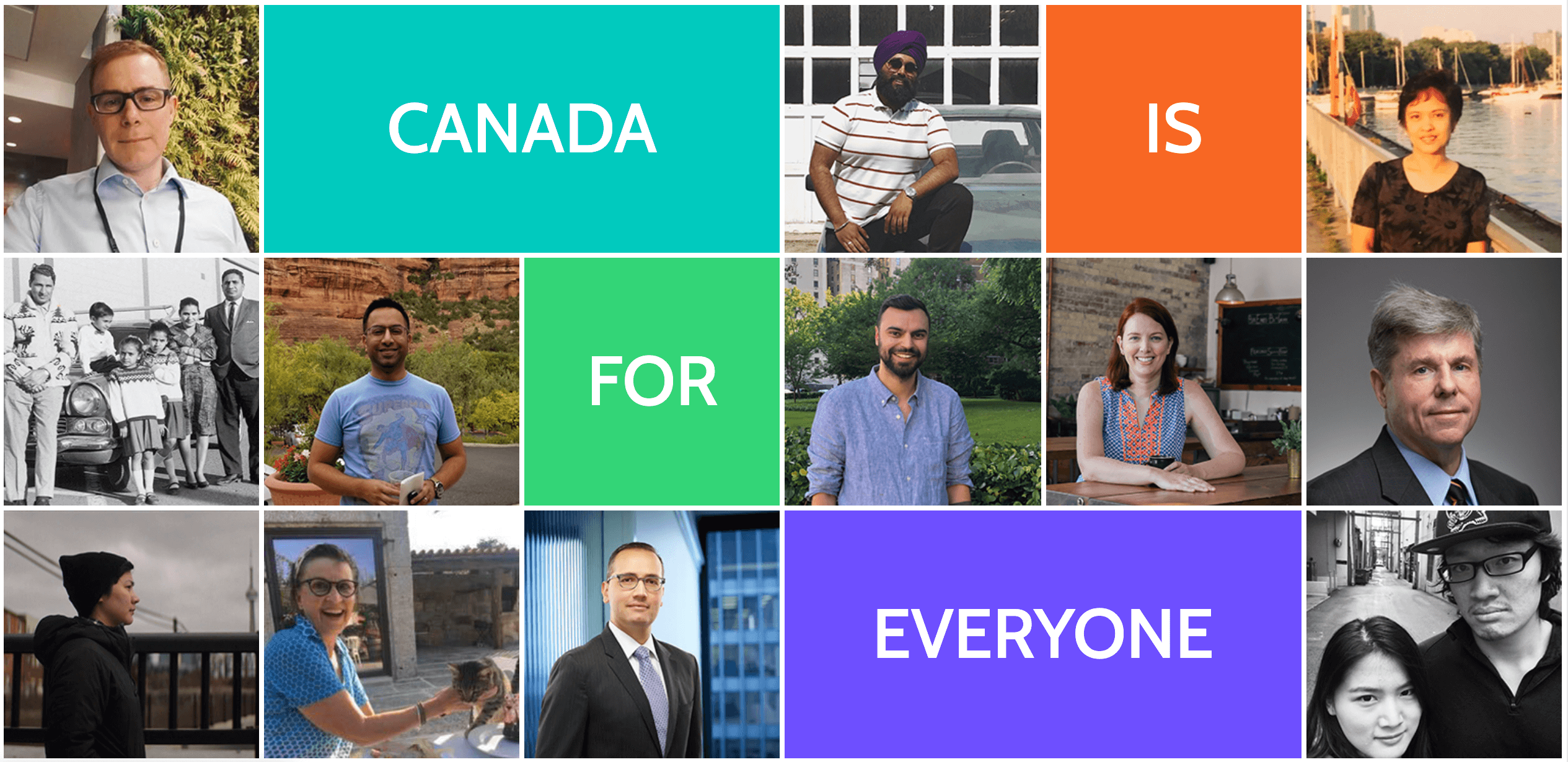
Zain Velji on how Everyone’s Canada uses storytelling to reaffirm the value of pluralism, multiculturalism and immigration. 

Tell us about Everyone’s Canada. How would you describe your purpose and what makes you unique?

Everyone’s Canada was created in the summer of 2019 in response to a concerning narrative that was emerging across the country — a narrative that sought to undermine Canada’s commitment to multiculturalism, pluralism, and immigration. Anti-immigrant sentiment, which was being stoked and weaponized by some politicians ahead of the federal election, seemed to be bubbling up across the country.

EC’s response was to share an extremely simple response to this narrative, though one that we sometimes take for granted: Canada is for everyone. It doesn’t matter what you look like, where you come from, or what binds your conscience because Canadian identity isn’t tied to a particular race or ethnicity, but is rather built around a set of aspirations.

What makes our organization unique is our commitment to sharing and uplifting this message through story-telling that highlights diverse perspectives. In 2019, we launched a popular series called #MyCanada, which encouraged Canadians to share their family history and their perspective on what Canadian identity means. The series acted as a reminder that there is no fixed or permanent concept of a Canadian — rather, there are only complex, layered, and competing concepts, all founded upon a dedication to diversity and pluralism.

This simple message seemed to resonate with various individuals and communities, particularly in the midst of what had become a noisy and divisive election. Moving forward, EC remains committed to using storytelling to push back against nascent or existing movements to undermine our collective commitment to multiculturalism in Canada, such as Bill 21 in Quebec, and highlighting ways that Canadians are fighting for a stronger future, such as the ongoing efforts to implement the Truth and Reconciliation Commission’s calls to action.

This is a critical moment for commitment and action on anti-black racism. It is prompting crucial conversations about structural inequality and violence that results in the loss of Black lives.  How does this relate to the work of Everyone’s Canada?

In line with EC’s focus on storytelling, our organization is currently developing a new podcast series called Black in Canada, which will introduce listeners to different perspectives on the Black experience in Canada. While much of the media is focused on the social upheavals and protests occurring in the United States, EC hopes to highlight the unique and multifaceted ways that anti-Black racism operates in Canada, and the efforts that are underway to combat it.

We are all navigating the pandemic in different ways. What’s a key insight from how Everyone’s Canada is responding to the crisis?

EC has sought to highlight the very concerning and underreported fact that COVID-19 has disproportionately impacted racialized communities in Canada. During the early stages of the pandemic, our organization focused on raising awareness about the COVID-19 outbreaks at meat processing plants in Alberta, which predominantly impacted immigrant and racialized communities in the province. Through op-eds, radio interviews, and social media, we aimed to highlight the authorities’ failure to protect vulnerable workers, which we believed too many people were willing to overlook.

This COVID-19 pandemic is a tragic example of how inequity and systemic racism hinder our ability to respond to a health crisis. It offers a reminder of the importance of fighting for an inclusive and equal Canada, one that makes an effort to protect and support marginalized or underrepresented communities.

What’s one big challenge you see facing Canada’s democracy? How are you working on this challenge or what solutions do you propose?

We believe that anti-immigrant sentiment is one of the greatest challenges Canada faces today. This sentiment has emerged despite the fact that immigration is a central component of our country’s history, and key driver of our economic growth today. As a country completely comprised of immigrants and Indigenous people, efforts to undermine immigration can only take the form of racism, xenophobia, and discrimination. Only by reaffirming and highlighting the value of multiculturalism, pluralism, and immigration, can our country move forward without descending into divisive and dangerous politics.

Tell us about how Everyone’s Canada is making its work more inclusive and building engagement with different communities. Any tips or lessons to share with others in the sector about decreasing barriers and increasing participation?

EC is committed to uplifting and sharing the work of other groups within the sector, and encourages different communities to reach out for collaborative opportunities. We often receive emails from other groups, asking us to highlight or share their work on social media, encouraging our followers to get involved.

Are there specific requests that Everyone’s Canada  has for the broader sector? Things you need help with, problems you’re trying to solve or wishes you have?

If you have a story to tell we would love to hear it from you. We are trying to grow our base of individuals to be profiled. And your story just needs to be your story – what does it mean to be Canadian? What is your ambition for Canada? And how would you describe the values of multiculturalism and diversity today.

For people looking to engage with you, how can they get involved? Who can they contact?

Visit our website and check us out on Facebook and Twitter. You can also email us (info@everyonescanada.ca).

Everyone’s Canada challenges an emerging narrative in Canada that undermines our commitment to multiculturalism, pluralism, and immigration. A narrative that claims that Canada only belongs to those of a certain background and experience, preventing many Canadians from calling this country home.


This is an unprecedented moment for democracy in Canada so we created Sector Spotlight to learn about how leading practitioners are responding to it. Have ideas for our next Sector Spotlight? Get in touch!

 

The Leaders We Need

Last month Professor Hahrie Han of Johns Hopkins University spoke about building power for social and political change at a DemocracyXChange pre-event. Her talk described this moment as one of disruption and rapid change. Current conversations about economic and racial justice are accelerating and generating demands for action from our democratic institutions. Han’s remarks raised the question: how do we create conditions that will enable the leaders we need to emerge?

Since the death in police custody of George Floyd in the United States, there has been unprecedented engagement with the link between police services and the disproportionate loss of Black and Indigenous lives in Canada. The call to defund the police in favour of reallocating resources towards community supports is steadily gaining traction in both Canada and the United States as the Black Lives Matter movement surges.

During this period media outlets have struggled to cover stories about systemic racism, prompting critical conversations about their objectivity. There has been an outpouring of stories from journalists of colour on social media and other platforms about the constant burden of navigating white supremacy in the newsroom and at leadership tables. This both compromises the quality of news coverage and constrains their careers. Other professions have followed suit, noting that the limited representation in their fields produces toxic work environments and impedes effective service to the public.

Community organizers, activists, academics and many others have long been speaking out against and fighting systemic racism. After countless commissions, reports and studies their message has now broken into the collective consciousness and is disrupting the default mode that has centred white privilege across our democratic institutions. In Canada, the central question can no longer be whether systemic racism exists — it always has. Similarly, it’s time to stop making selective comparisons with ‘worse’ instances of racism in the United States, as a source of distraction or comfort.

Popular opinion has shifted such that concepts and views previously unthinkable are now mainstream. Han attributed this change to the public reaching its limit and this signals an important cultural shift. Now that we are experiencing the world through a COVID-19 lens, existing inequalities are magnified and new, imaginative solutions seem within reach. In order to stay relevant, institutions of democracy must work quickly to adapt and reflect our pluralistic multiracial society.

Han expanded on the importance of contemporary leaders responding with agility on shifting terrain. It is now critical that leaders show the ability to balance tensions – to move with ease from the top down and bottom up – and to adeptly navigate both constituency and institutional demands. Aspiring and existing non-white leaders working in predominantly white spaces know all too well how to balance duality: for them, being conspicuous and invisible at once is a necessary survival skill.

Struggle is inherent to democracy – it is an unavoidable element and source of dynamism. As we are witnessing, this current struggle to address systemic racism is rapidly shifting expectations and challenging institutions to keep pace. According to Han, the practice of democracy is going through a rapid transformation, one that entails rethinking how the public holds its leaders accountable.

At this moment I ask: are these the conditions that enable the leaders we need to emerge? The momentum behind current discussions about addressing systemic racism is encouraging and the inspiring product of an engaged citizenry. While these may very well be the ideal conditions to produce the leaders we need, their emergence is contingent on having space to step into.

Organizers know that in order to truly change the guard they must sustain their efforts to secure change in the public consciousness, across professional cultures and through policies. The new standards of accountability are calling on current leaders to cede some of their privilege in order to strengthen democracy. The pressure is on to respond because the calls for meaningful, effective and rapid change – they are only increasing.


Sabreena Delhon, Open Democracy Fellow